Saturday, April 18, 2009

Twitter in Thailand


I've been following the twitter feed on #redshirt for a week now (since April 11, the day the red shirt demonstrators invaded the Pattaya resort hosting the ASEAN meeting). (See an earlier post on the civil unrest there.) It's been truly fascinating in many ways.

(It's a big disadvantage, of course, not to be able to read Thai; so there is a segment of the feed that I can't address at all.)

Here are a few things I've gathered in the week of reading. I've become familiar with a couple of voices -- bangkokbill, andrewspooner, anitchang, smartbrain, piriya ... I've learned a bit about the timing of events in Bangkok during the Sunday and Monday showdown with the government. I've probably gotten a bit of the flavor of the issues and emotions that divide the contending protest movements, red and yellow. I got some useful links to valid news and academic sources on the conflict.

And I've viewed the controversy about who is REALLY dominating the twitter feed -- yellow shirts or red shirts. Andrew Spooner is out front in asserting that yellow shirts are spinning the facts in the twitter feed; others characterize him as "pro-red shirt" and biased in that direction. It's gotten a bit personal -- maybe it's a good thing Spooner is off on a travel article assignment. But actually -- I'm not seeing the evidence of bias that Spooner sees.

Another interesting aspect of the feed -- there are only a few eye witness real time comments from the streets -- certainly few compared to the ongoing commentary by the regulars. And there appear to be no real time reports from participants -- red shirts or conceivably cops and soldiers.

The biggest issues of debate that people are clashing about on twitter are important ones. Did the government use more force than necessary? Were there more deaths than the four that were reported? Were more bodies secretly taken away? (This is a persistent theme in Spooner's postings.)

And second, how does the "street" feel about the demonstrations? Is there more support for the yellow shirts and the current government, or is there mass support for the red shirts and Thaksin? Are the red shirt demonstrators mostly concerned about democracy and social progress, or are they dupes of Thaksin's party?

Spooner makes what sounds like a valid point about access -- it makes sense that poor people who might support Thaksin are less likely to have access to twitter and the Internet. But since you can tweet straight from a cell phone, this doesn't seem to be much of a barrier. There are a lot of cell phones in Bangkok!

What never really gets addressed directly is the extent of mob violence exerted by red shirts on several occasions last weekend: the invasion of Battaya, invasion of the ministry of interior, smashing of the vice minister's car and serious beating of the official himself, and the burning of numerous buses. All of this is well documented in the press and on YouTube -- but almost never mentioned in the twitter polemics.

And of course there's the mysterious assassination attempt on the life of a former official, Sondhi, who was a prominent figure in the yellow shirt demonstrations in the fall -- some mention of this shooting on the twitter feed but no real news.

What is truly fascinating about the demonstrations in Bangkok this past week, and the twitter feeds that emanated as a result, is what it suggests about the future. Imagine that 10% of demonstrators contribute comments and feelings every few hours; imagine the freelance commentators and partisans are putting in their interpretations; and imagine the parties and the government make an effort to chime in and provide spin, interpretation, and misinformation. This would be a torrent of as many as four thousand tweets an hour for an extended time -- perhaps 350,000 tweets to make sense of in a week. What a data-rich cacaphony for the journalist, the sociologist, and the intelligence analyst to try to make sense of. Thailand 2009 isn't the twitter revolution -- but maybe the next one will be.

Monday, April 6, 2009

What's next?


We've seen several waves of hardship for working families in the past eight months in many parts of the U.S.: mortgage foreclosures, job losses, reduction of hours of work, and pressure by employers on health benefits. And state governments around the country are under huge fiscal pressure, leading them to attempt to cut support for social programs and important social services. And many of those governments are themselves laying off state workers. So there is already an unprecedented level of economic and personal distress in the country.

But no one seems to think that we've seen the worst this recession has to offer. So what's next?

One part of the story seems pretty clear. There will be more layoffs, more plant closures, and more business bankruptcies in the coming six months. So more families will suffer the pain and dislocation of job loss. The national unemployment rate is officially estimated at 8.5%, and economists expect it to rise above 10%. This means another two million job losses in the coming year or so. And each unemployed person affects several around him or her -- dependent children, spouses, college-age children, even aging parents. That amounts to several million more people about to be affected. (Here's a link to the Bureau of Labor Statistics.)

It also seems likely that many more people will lose their homes through foreclosure. (Here's a recent map of mortgage delinquency rates based on data compiled by the New York Federal Reserve Bank.)


It would take more of an expert than me to try to guess what surprises await us in the financial sector -- how many more failed banks, how long the credit drought will continue, how much resistance distressed home mortgage holders will meet in efforts to renegotiate their loans and try to keep their homes. But it doesn't seem likely that banking and finance have seen the worst yet.

We can pretty well predict that services and support for urban poor people will diminish further, as state budgets contract along with the economy. And public health experts can probably estimate the effects that contraction will have, on the health and nutrition status of poor communities. And what happens to whole communities when unemployment benefits begin to run out? How will food pantries and private services cope with increasing urgent need?

And what about worker militancy? Isn't it somewhat surprising that there hasn't been more of an organized reaction in the United States to all these shocks by the ordinary people who are experiencing them? Is it possible that this passivity and acceptance will begin to change as the months of hardship wear on into years of reduced quality of life?

The photos above are from the 1930s, the period of the Great Depression. The point here isn't that we're approaching a similar time. It is simply that economic hardship is real, and it forces new kinds of social action and private strategies of self-preservation.

I suppose the hope everyone shares is that the economy will reignite. Demand will begin to recover; businesses will start to rehire workers; new investments will be made that result in productive innovations. And public revenues will begin to recover as well, as family incomes, business profits, and property values start to recover. So we'll be able to pay for the social services we want and simple fairness demands.

Somehow, though, that recovery seems a long way off.

Thursday, April 2, 2009

Anti-NATO protests in Strasbourg


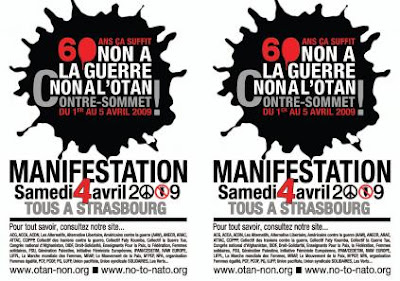
There are organized and escalating protests taking place against the NATO summit in Strasbourg this week (news; news; Aljazeera report). Calls for protest have come from anti-war and leftist organizations throughout Europe, and there is rising concern in the French and German press about the possibility of violence in the streets. These concerns are realistic, since clashes between demonstrators and police have taken place already in the past twenty-four hours.

These protests are separate from those taking place in London at the G20 meetings, and there appears to be an escalating cycle of violent clashes between demonstrators and police and security forces. Various European anti-war organizations have been mobilizing to bring their supporters to Strasbourg -- for example, see this website for Manchester Stop the War Coalition and this call for action from Americans for Peace and Justice (posted in Italy).

What is the composition of the protest movement in Strasbourg today? It would appear to be largely organized by anti-war and pacifist groups; groups who are opposed to European involvement in Afghanistan; some groups protesting the recent war in Gaza; and, presumably, a scattering of anti-globalization and anarchist groups from various parts of Europe. Anti-NATO demonstrations have taken place with some regularity in a variety of locations in Europe in the past year.

President Obama will be visiting Strasbourg and Baden-Baden this week for the NATO conference, and security in the city is very intense. The French public is very tuned into the developments that are taking place in the city. There will be a great deal of American and European attention to his visit. It is very striking, though, that there is virtually no coverage of the protests and clashes that are currently taking place in Strasbourg in the American press. The New York Times appears not to have covered the story, though it has covered the NATO conference itself.

It would be very interesting to use the tools available on the web to do a sociology of the protests taking place today, based on the links it is possible to discover among organizations through websites and calls for mobilization. Sidney Tarrow is one of the contemporary social scientists who has made a substantial effort to provide detailed analysis of the networks and organizations that have converged in anti-globalization protests in the past decade or so (The Global Justice Movement: Cross-national And Transnational Perspectives).

Sunday, March 29, 2009

Unemployment across the US


There is a good interactive map of unemployment rates at the county level across the US in the March 29 New York Times. Here is a snapshot, but be sure to visit the Times site for the interactive version. The map is based on January 2009 data, and it represents a national rate of unemployment of 8.5%. But there is a tremendous range across regions and counties.

There are many noteworthy details on the map. Northern California and Oregon somewhat surprised me; Harney County, Oregon, has a rate of 19.7% unemployment, and Trinity County, California, has a rate of 20.9%. These are staggering numbers for these locales.

My own state, Michigan, has a very wide range of unemployment rates across both rural and urban counties. Wayne County, home of the city of Detroit, has a relatively high rate of 14.2%, and Genesee County, home of Flint, also has a high rate (14.8%). (By comparison, Onondaga County, home of Syracuse, New York, has a rate of 7.4%.) Several Michigan counties with mid-sized cities show relatively low unemployment rates: Washtenaw County (Ann Arbor), Kalamazoo County (Kalamazoo), and Kent County (Grand Rapids) have relatively low rates (7.3%, 8.4%, 9.8%). But several other counties in the state show rates in excess of 18%: Cheboygan County (21.8%), Baraga County in the Upper Peninsula (23.4%), Sanilac County (18.9%), and Iosco County (18.5%). What this shows is that the unemployment crisis is not evenly distributed across the state or the region; some counties are much more seriously affected than others. And some of the highest rates are in counties with agriculture and extraction as primary industries -- manufacturing counties in Michigan are generally in the middle rank.

A quick visual inspection suggests that Michigan and South Carolina are the states with the highest proportion of high-unemployment counties; California and Oregon are also clearly on the high end of the unemployment crisis.

The tool also allows the user to select for rural, manufacturing, metropolitan, and "housing bubble" counties.

I suppose that the central truth that this map supports is the fact that the employment crisis has affected regions and economic sectors very differently -- across large regions and within states. So here, as with so many social variables, it is important to disaggregate the national and state data, to get a better idea of the range of effects a given economic circumstance is creating for individuals and families.

Tuesday, March 17, 2009

Impact of the crisis


We're now months deep into a financial-economic-employment crisis across the country, and it's especially severe in Michigan. What are some of the real impacts of this economic downturn on ordinary people?

The most visible impacts are on jobs and homes. Michigan's unemployment rate has increased sharply in the past three months, to a current national high of 11.6 percent in January. There have been large layoffs in the auto-related industries in the state, and non-automotive businesses are now reducing their workforces as well as a result of reductions in business and consumer spending. Restaurants, retail shops, law firms, and accounting firms are eliminating positions, so job insecurity extends across the blue collar and white collar spectrum.

The loss of jobs feeds into a worsening mortgage foreclosure crisis in Michigan. Even before the surge on job losses Michigan had a high rate of troubled mortgages. That number now threatens to increase as a result of families' loss of income, though there are a variety of new measures designed to help families to hold onto their homes.

A measure of the social distress for families in Michigan is the volume and nature of 2-1-1 calls that have been received over time. (2-1-1 is a growing national service in many areas that provides referrals to agencies and other resources for families and individuals facing difficult issues.) The United Way of Southeast Michigan provides detailed reporting of the volume, subjects, and demographics of its callers (link), and the results over the past 12 months are striking. Calls received in January 2009 are up by 30% compared to January 2008, at 22,518. The top five services for which referrals were provided included utility assistance, food, housing, temporary financial assistance, and employment. And emergency food providers such as Gleaners report a sharp increase in the amount of demand for their services in the past six months.

So how about the 80-85% percent of Michigan families who are still employed? (In addition to the 11.6% of people who are officially unemployed, there is a population of "hidden" unemployed people who are not counted in the official unemployment figures.) How has the crisis affected the majority who have not lost their jobs? It's pretty clear that just about everyone in Michigan has been affected by the crisis. Anxieties about retirement investment accounts are at the top of the list -- especially for people in their fifties or older. But a second major anxiety stems from job insecurity. With all the bad economic news, whose job will be the next to go? There is worry too about employers' health benefits -- will these benefits continue in their current form in the current economic environment? And these anxieties have led people to rethink their spending and consumption habits -- leading, of course, to less demand in many sectors and perhaps another round of job reductions. Sales tax collections in Michigan fell by 18% in February from January; this is a direct indication of sharply reduced consumer spending (link). (Here is a report from the Chicago Federal Reserve Bank describing recent trends in Michigan retail sales.) And major purchases like automobiles and trucks seem to be on hold -- witness the roughly 50% drop in demand for cars and trucks in recent months.

Another hardship that many families are experiencing is the frozen credit market and the stagnant home sales performance. Families who need to sell their homes are finding that there are few prospective buyers. And families looking to buy a home or a car may have substantial difficulty in finding a lender to provide the mortgage or car loan.

Add all these problems to a chronic American issue -- the lack of medical insurance for upwards on 50 million Americans -- and you have a rising financial and personal crisis for thousands of households in Michigan: how to pay for medical treatments when health benefits go away, or when you don't have insurance at all. Unreimbursed care has increased sharply in hospitals in Michigan, resulting in severe financial pressures and the need for further cost-cutting; health systems in Michigan are currently laying off workers to adjust their budgets to current revenues.

So the impact of the current recession is sharply differentiated between people who have lost their jobs and those who haven't. The first group is in serious, daily distress, having a hard time keeping their families provided with the necessities of life. The second group probably divides into segments with different levels and kinds of anxiety -- those who have realistic fears of losing their jobs in the next wave of layoffs, those who are concerned that they may lose lose benefits or wages in the next year or so, and those who are anxious about the future value of their retirement savings. And it all adds up to a set of communities that are being forced to cope with a wide range of personal hardships, almost across the board.

Tuesday, March 10, 2009

Social hate

This is a difficult posting to write. The impetus comes from an exhibit presented by the Jim Crow Museum of Racist Memorabilia at Ferris State University in Michigan (link). The curators have put together a set of artifacts that capture horrific attitudes towards African-Americans, Asians, gays, women, and other individuals and groups in American society, extending over a century of our history. There are photos of mass rallies of the Ku Klux Klan in the midwest; images of the lynchings of Emmett Till and other African-American victims; t-shirts with racist images of blacks, Jews, Asians, Latinos, and gays; photos from the scene of the Oklahoma City bombing; and recent examples of racist depictions of President Obama. And, of course, it's not just about iconography; it's also about real violence against individuals from these groups. Hate-based murders continue to occur in the United States.

Just viewing these images is a profoundly disturbing experience. But here is the really difficult part: our society continues to embody these strains of hatred somewhere. And it continues to reproduce these hateful beliefs and attitudes for the next generation. We want to imagine that our society is peace-loving, tolerant, respectful of difference, and ultimately "good neighbors" for all members of our society. And this is certainly true for a very high percentage of Americans. But the exhibition makes it all too plain that this is not the case for everyone. There are individuals, and more importantly, there are groups, for whom racial, sexual, and religious hatred is a fundamental social and psychological reality. As investigators for the Anti-Defamation League (link) and the Southern Poverty Law Center (link) have documented, these extremist groups continue to exist, and they continue to recruit new adherents using sophisticated social media (web pages, video games, chat rooms), as well as more old-fashioned means of mobilization.

How are we to come to grips with the idea that some of our fellow citizens -- in our own communities, in our state, and in our country -- have such despicable attitudes and behaviors towards other human beings? And what precautions should our society take to defend itself against the violent manifestations that these attitudes and groups sometimes lead to?

It seems that schools have done a pretty good job of conveying the values of racial equality and social tolerance to our children. This has been an important priority for the past several decades. But at the same time, the hatred documented in the exhibits mentioned here can still be found among young people as well -- not just gun-toting aging militia types. (Here's a resource on youth hate crimes.)

We would all like to imagine that the twenty-first century is going to be a better time than the twentieth century. And a big part of that hope is the idea that hatred and violence between groups will subside, replaced by the values of tolerance and civic equality. Anti-semitism, racism, hatred of gays and lesbians, and the forms of violence that are associated with these attitudes, must disappear. It is tough to be reminded how far we are from that ideal in the first decade of the new century.

Wednesday, February 25, 2009

Mobile social mapping?

Wouldn't it be interesting if our GPS units gave us basic social data about the spaces we pass through, along with advice about where to find the closest fuel stop? This would function as a sort of "social reality meter" that would render more visible the social realities and human inequalities we traverse as we travel.

Such a device is entirely possible. It would require a spatially coded social data base, including characteristics such as infant mortality, high school completion, poverty, crime, single-parent families, home ownership, property values, and as many other characteristics as we might be interested in. These features would be attached to a geographical location (a census tract, for example, with a boundary file), and the map would dynamically display several selected variables as we travel through the region.

This kind of GIS mapping is commonplace on the desktop. (See ZipSkinny and SocialExplorer, for example.) But putting it into a mobile device -- a GPS unit in the car or a GPS-equipped cell phone -- would be a way of greatly extending our perception of the social landscape around us.

Here's a possible snapshot of violent crime data as we drive across Chicago:


Or a drive through Washington D.C. showing the patterns of unemployment in the metropolitan area:


Or this drive through Cleveland observing the distribution of poverty across the city (measured by eligibility for food stamps):

The idea is "location-based social awareness" using the same technologies that cell phones and GPS devices currently use to keep track of local points of interest or "locations of your friends right now"; but providing the user with enormously greater ability to "sense" the social landscape around him or her. Socially conscious iPhone programmers -- how about it!

ChangingSociety video

Loading...